
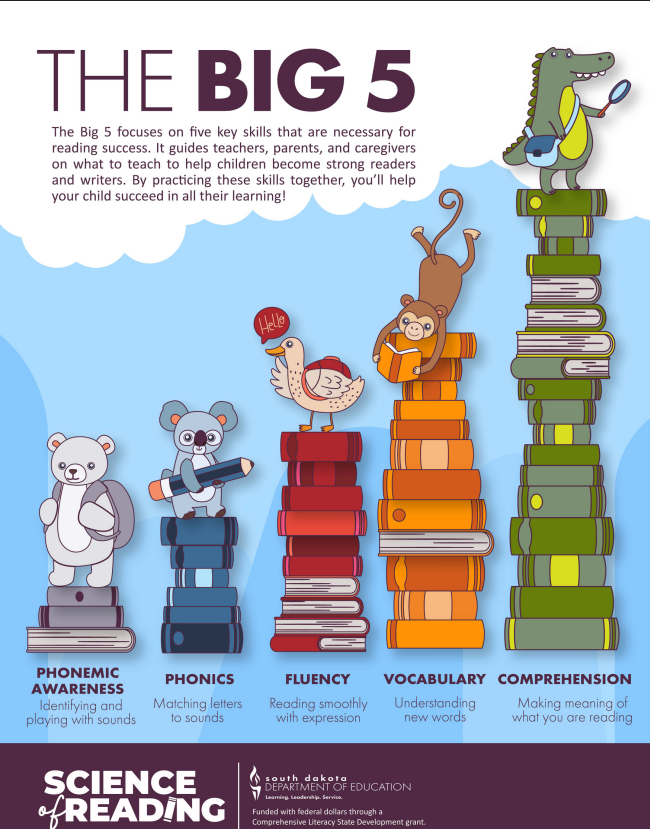
Like the stacks of books in this graphic from the South Dakota Department of Education, the Big 5 are five key skills that build on each other, helping children become confident, capable readers and writers.
1. Phonemic Awareness (The Sounds of Spoken Language)
What it is: The ability to hear, identify, and manipulate individual sounds (phonemes) in spoken words.
Key detail: This happens strictly with your ears, before letters or books are even introduced.
At-home example: Clapping out the sounds in the word cat (/c/ - /a/ - /t/) or guessing a word when you stretch it out ("What word do I get if I say s - sun?").
2. Phonics (Connecting Sounds to Letters)
What it is: Matching written letters (graphemes) to spoken sounds (phonemes) so a child can decode and spell words.
Key detail: It turns the "code" of the alphabet into actual words on a page.
At-home example: Pointing to the letter b and saying the /b/ sound, then blending /b/ + /a/ + /t/ to read bat
3. Fluency (Reading with Speed, Accuracy, and Expression)
What it is: Reading smoothly, quickly, and naturally, like talking, rather than sounding out every single word robotically.
Key detail: Fluency acts as a bridge; when a child doesn’t have to struggle over every word, their brain has the energy left to understand the story.
At-home example: Reading a favorite picture book together multiple times or reading aloud with voices for different characters.
4. Vocabulary (Knowing What Words Mean)
What it is: Knowing the meanings of spoken and printed words.
Key detail: Kids cannot understand what they are reading if they do not know what the words mean.
At-home example: Explaining new or interesting words (like enormous or curious) while reading a storybook together.
5. Comprehension (Understanding and Making Meaning)
What it is: The ultimate goal of reading, making sense of what the text is actually saying.
Key detail: It involves connecting the story to what your child already knows, asking questions, and summarizing.
At-home example: Stopping halfway through a book to ask, "Why do you think the character did that?" or "What do you think happens next?"